Hybrid work has changed everything. Teams are scattered, and old landlines can’t keep you connected like they used to. But as time has changed, technology has too. A VoIP number lets you take calls over the internet, giving you flexibility, lower costs, and easy growth without the headaches of traditional landlines. Whether you’re a small business owner tired of high bills, an IT manager supporting remote staff, or part of a distributed team, VoIP numbers make your phone system work smarter.
In this guide, we’ll explain what a VoIP phone number is, how it works, the types which are available, key benefits. Plus, we’ll walk you through some simple steps to get started with a reliable VoIP service.
What is a VoIP Phone Number?
This is a virtual telephone number that routes calls over an internet connection instead of via physical lines. It looks, sounds, and acts like any regular business number (your customers will dial it the same way).
Unlike some tech with is tied to a specific location and single device via copper wires, this technology isn’t restricted by place or hardware. You can use it like a landline number, computers, or mobile apps anywhere (so long as you have internet), routing VoIP calls through cloud systems for true freedom. This matters hugely for business because it supports mobility and control that old lines can’t match:
- Work from anywhere without complicated forwarding
- Ring multiple devices at once to catch every call
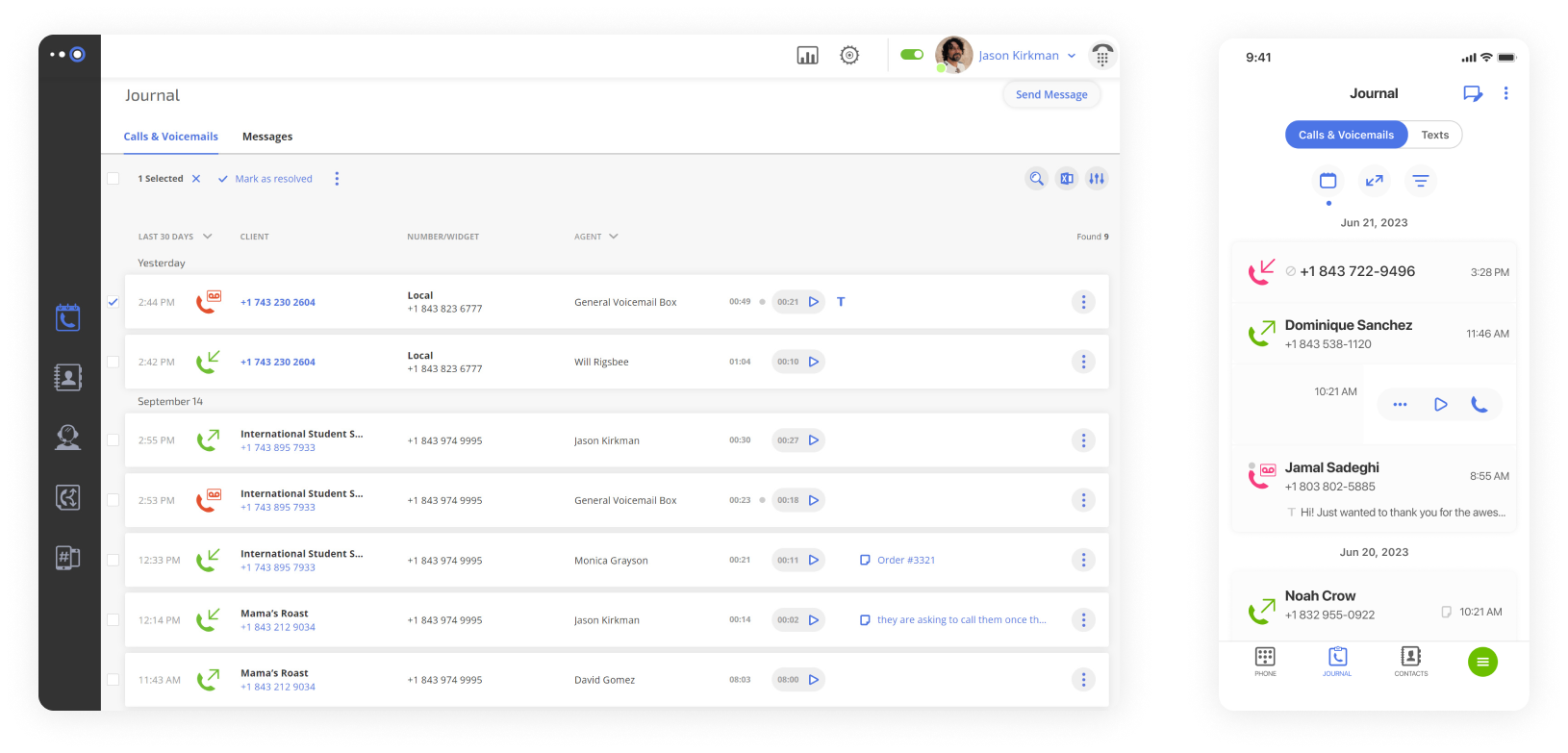
- Manage everything centrally from one dashboard
- Add VoIP numbers instantly as you grow
- Cut costs on hardware and long-distance fees
How Do VoIP Numbers Work?
A VoIP number turns your voice into digital packets sent over the internet, then rebuilds it on the other side; in this way, it’s much more flexible than old circuit-based systems that need dedicated lines.
Here’s the simple step-by-step:
- Voice conversion to data packets: Your words are captured, encoded with codecs (G.711 or Opus for clarity, for those who are more technical), and split into packets.
- Transmission over the internet: Packets travel over IP phone networks to the VoIP provider using SIP trunks*.
- Reassembly and playback: The packets reorder, decode, and play as smooth voice, with codecs handling latency or jitter.
*SIP trunks allow your small businesses to get unlimited “lines” without hardware.
Aim for 100 Kbps per call, and make sure that your provider uses QoS (to prioritize voice calls), and VLANs to separate traffic.
| Concurrent Calls | Minimum Bandwidth | Recommended |
|---|---|---|
| 1–5 | 500 Kbps | 1 Mbps + QoS |
| 6–10 | 1 Mbps | 5 Mbps |
| 11+ | 2 Mbps+ | 10 Mbps + VLAN |
Technical essentials
Some of these terms are difficult, we know. And you don’t need to be a technical expert. But some of these terms you really should know. Terms like:
- Network quality: It’s how you measure how good your call quality is over the internet.
- Latency: This is the time between you finishing speaking (on one end of the line) and the other person (on the other end of the line) hearing what you said.
- Codecs: We mentioned this before. It’s the program that takes your voice and actually packages it in order to blast it over the internet and get it to the other person on the line.
- SIP Trunk: These are “lines,” instead of the physical lines that accompany landline calls.
Types of VoIP Numbers
Just like with traditional phone numbers, there are different types of virtual numbers. Each are non-fixed VoIP, and each come with different benefits for people in different situations.
Local phone numbers
Local VoIP numbers use area codes to give your business a local vibe. People are more likely to pick up with area codes they know, and getting a local number can help with that. This ultimately builds trust with customers who like nearby businesses, even if you’re remote.
Toll-free numbers
These numbers are free to call (you’ve probably seen them on TV commercials before). With prefixes like 888, 877, 866, 844, 833, and 800, they are also extremely easy to remember. These are ideal for support lines, as people will feel encouraged to call. They also send a signal that you’re serious and open nationwide.
Vanity numbers
VoIP vanity numbers can be toll-free, local, or otherwise. The unique thing about them is that they use the number pad to spell words out. So 1-800-356-9377 (not easy to remember) becomes 1-800-FLOWERS (significantly easier). If you advertise on billboards, or just want your number to be easier to remember, these are the types of numbers you should pursue.
International numbers
These are exactly what is on the box: numbers from other countries. If you are calling people abroad, it seems like a local number, and it’s cheaper for them than calling an American number.
It’s critical to have one if you do international commerce. Without it practically no one will call you (international calling is enormously expensive), and people will also likely not trust your business.
DID phone numbers
These are specific to inside a company; they are phone numbers with extensions. You would only need something like this if you have a larger company or if you want to seem like you have a larger company; if you’re pursuing the latter option, however, be careful, as customers may be annoyed if they have to scrounge around looking for an extension number.
Virtual phone numbers
You’ve heard us talk about these. Virtual phone numbers are any of the above, but they’re online-based instead of being landline-based. They don’t operate from any fixed spot or phone, and you can forward them to other numbers.
These offer premium flexibility. Forgot your cell phone? No problem, log into your laptop and make the call. Forgot both? Use your smart watch.
Ported numbers
These are not really a specific “type” of number, but they are worth mentioning. These are existing numbers which are moved (“ported”) from one provider to another – in this case, to a VoIP phone system.
People port their numbers when switching because they want to keep their number; they may like it, or they may have built their brand around it, but they want the benefits of a VoIP service provider.
Number porting can take a few days to a few weeks, though it is usually on the shorter side.
VoIP vs Landline
We won’t fool you: VoIP phone numbers are superior to landlines if you are seeking flexibility. There’s a reason that fewer than a fourth of American households have a landline, down from over 90 percent decades ago. They’re easier and more convenient:
| Aspect | VoIP | Landline |
|---|---|---|
| Device Flexibility | Apps, softphones, desk phones | Just fixed phones |
| Cost | Cheaper plans, no extras | High monthly, hardware |
| Features | IVR, recording, links | Simple, add-ons cost more |
| Management | Online dashboard tweaks | Call techs for changes |
| Reliability | Needs internet, backups fix | Runs in outages |
Are you a solopreneur? You’ll love the mobility these numbers offer. Are you a burgeoning SMBs? You can scale easier. Is your team distributed over a large geographic area? You guessed it: it makes it easier than ever to stay connected.
How to Get a VoIP Phone Number?
If you’re convinced – great! – then you should know that you don’t need to worry: getting one is easy. There shouldn’t be any significant waits, and there is an absolute plethora of choices out there for you.
Still though, you should jump through some steps first:
- Choose a provider: Make sure that whoever you go with is well-reviewed (meaning sites like G2) and that they have the features and scalability you need.
- Test the network: Make sure they have a demo you can try, or some other way to get your fingers on the wheel.
- Select phone numbers/port: Once you’ve picked a provider, pick your number! Or let it be randomly assigned, if you don’t care.
- Set up E911: You have a VoIP number, which – unlike a landline – it’s not tied to a location. So make sure to set up E911 so first responders can get to you.
- Go live: Get going! Make sure to continuously monitor for any bugs or anything which isn’t working right. Calibrate your settings as necessary, and reach out to your provider’s support staff if something really is not working as promised.

VoIP Features That Matter
When you get a VoIP number, you’ll notice that there are an absolute metric ton of features wich come with VoIP technology, and it can be hard to tell what’s actually important and what is just filler. Below are the features which you absolutely must have in order to be successful, no matter the size of your business:
- Auto attendant/IVR: These menus can help guide your calls without a live person actually talking to someone. Some providers even allow you to record your own voice for various steps, sparing your customers from hearing a robot.
- Call recording: This is crucial for so many things. Review of previous calls, note taking, legal protection (if someone claims you promised something you didn’t, for example).
- Voicemail-to-email: Everyone hates listening to droning voicemails. So don’t. Voicemail-to-email, also called automatic voicemail transcription, saves you time by letting you quickly scan a voicemail instead of listening to it.
- SMS/MMS: The modern world requires texting. You don’t have to always text your customers, but it sure helps to have the option.
- Custom caller ID: This shows your voice over IP number when making a call and hides your personal number, giving you privacy and keeping a divide between your business VoIP number and your personal life.
Benefits of VoIP Numbers
Unconvinced? Here are a few more benefits of using a VoIP number for your business calls.
Cost Savings and Predictability
A lot of providers allow you to do month-by-month contracts; you’ll have real flexibility to leave whenever you need. Plus, they cost significantly less than landline phones.
Scalability and Mobility for Remote Teams
We’ve mentioned scalability before, but it truly is important to be able to grow and shrink as you need to. You never know where the future is going or what it will hold – to be successful, you’ll need to be able to have the flexibility offered by a VoIP business phone number.
Same with mobility. If you can’t be mobile, then you’re drastically limiting your options, both in your customer base and your hiring potential.
CRM and Software Integrations
CRM allows you to unlock a range of capabilities, from easier organization to automatically having information about a caller (you previously entered) surfaced as you call them.
Advanced Features
There are also just a ton of features, including lots we have not discussed here. Call routing and queues, call waiting, and multi-level IVR – so much more that you can do that you can’t do with a standard landline phone, or even a normal cell phone.
Disadvantages of Using VoIP Phone Numbers
Like with everything else, there are some disadvantages to using a VoIP business phone number, of course. Keep them in mind as you go about your search for the best phone line for you:
Internet Dependence
If the internet is slow, your calls are going to have issues. They may be choppy, or they might just get dropped. Sometimes, with bad signal, you simply can’t fix this. But you can test your own Wi-Fi to make sure things are as fast as they can be.
Power Outages
Without power, you don’t have Wi-Fi. Without Wi-Fi, you don’t have a VoIP network, which means you don’t have calls (it’s the same issue with a traditional phone line – no power means no phone). You can fix this by making sure that your computer (if you use it for calls) has a connection to satellite signal. If you use your phone, make sure you have an extra charging pack.
Potential Latency
Because of poor signal – or just issues transmitting through the internet – your VoIP phone service can have latency problems, which means it may take a bit for the other person to hear you. Run QoS tests regularly (particularly if you’re detecting issues) to see if it’s a network issue.
How Much Do VoIP Phone Numbers Cost?
Plans vary depending on size, provider, country, and what you want to do with them. But generally speaking, you should expect to spend anywhere from $15 to $100 per user per month.
Omnivoice, for example, will run you:
| Tier | Per User/Mo | Includes |
|---|---|---|
| Solo | $9 | Calling basics |
| Team | $19 | Recording, links |
| Company | $99 | Analytics |
Risk Management: VoIP security, Phone Fraud, and Call Quality
Even the best telephone VoIP system isn’t immune to threats, but modern providers have strong defenses in place. Phishing and caller-ID spoofing are the main scams. Here, attackers pretend to be trusted contacts to steal credentials or money. Reputable VoIP services can fix this with end-to-end encryption (TLS/SRTP), mandatory multi-factor authentication, and real-time fraud monitoring that blocks suspicious telephone numbers before they reach you.
For call quality, prioritize QoS on your router and keep issues under control so conversations stay clear. To avoid downtime, set up automatic backup connectivity. Things like cellular failover or a secondary internet line can keep your VoIP phone line alive even if the primary connection drops.
To be in compliance with local rules and regulations, register accurate E911 addresses for every VoIP number and choose a provider that follows data-protection rules (like GDPR or HIPAA). With these layers (encryption, authentication, smart routing, and solid backups) your VoIP system is both secure and reliable.
Use Cases
VoIP numbers shine in real business scenarios, turning your phone system into a versatile tool with features like call forwarding for seamless connectivity.
Sales Teams
Sales pros use VoIP numbers for local presence dialing to build trust in target markets, vanity options in ads for easy recall, and call recording tied to CRM logging to review interactions and close more deals faster.
Customer Support
Support departments leverage toll-free VoIP numbers to encourage calls, IVR for efficient routing, shared lines to handle volume without drops, and analytics to spot trends and improve response times.
Remote Teams
For distributed workers, multi-device ringing on softphones keeps everyone reachable via business phones, while strong security posture protects sensitive discussions across locations.
Marketing Agencies
Agencies deploy VoIP numbers with call forwarding to track campaign performance, integrate with tools for lead routing, and use custom greetings to personalize client outreach, boosting engagement metrics.
How to Get Started This Week: What to Do, Step by Step
You want to get going? Great! Here’s what to do.
1. Assess your network and needs
Figure out what you’ll be using your VoIP phone numbers for. Will you be making a few outgoing calls now and then, or will you have lots of people handling lots of incoming calls? If it’s the latter, you’ll need a stronger network.
Talk to professionals about internet speed and the bandwidth you’ll need.
2. Shortlist VoIP number providers
There are a massive number of VoIP providers. You should weed them out by casting a wide net and slowly closing it.
That includes putting a list together exactly of what you need, and crossing anyone off the list who does not have it. Then, from what remains: look at reviews and ask pointed questions of their sales staff.
3. Run a pilot
If your selected provider does not offer a demo, you probably should look elsewhere. If they do, take advantage. Really dig into it and use all the features, even the ones you think you won’t need.
4. Train your team
You’ve picked one? Great. Make sure your team knows how it works. If your provider offers training, take advantage. If they don’t, still make sure to set aside the time to ensure that everyone knows how things work; the best, well-known providers won’t be useful if you don’t know how to use them.
5. Go live and monitor KPIs
Get going, but right before you do: write down some KPIs (key performance indicators) that you’ll want to monitor. And make sure that you’re hitting them. If not, you either need to change your strategy or you’ll need to change your provider.
Make Your Number Work For You
Your number used to be something which was useful for being contacted. That was it. Now that’s changed: your VoIP numbers can work for you. Find your provider, build your team, use your features, and achieve your goals!
FAQ
There is no difference in the output; you'll be able to make calls and use your features. But VoIP providers hosted by a third-party don't require hardware on-site; if it's stored on-premises, you may need to rent or buy expensive technology.
There are federal, state, and local regulations when using VoIP technology in the United States - and that web can get pretty difficult to navigate. Don't just google it: staying in compliance can require asking a lawyer to find out what you need to do.
Yes, the technology can work for healthcare and finance, but only if the provider supports required compliance standards like HIPAA or PCI DSS, offers strong security controls, and allows proper call logging, encryption, and access management.
Analytics and progress tracking reports are crucial to making your campaigns work for you. Real-time reports can help you tweak things which might be wrong (are you making calls at the wrong time? Should you use toll-free numbers?) and can help you zero in on agents who may need a helping hand.


FAST • SECURE • RELIABLE
business communications